Feeds:
Posts
Comments

10.    Describe other possible models for the “Filling Out the Cosmic Picture” sections. (minimum 100 words)

Filling out the cosmic picture is the way in which we call the various beings into our ritual center to take place in our rite. Most typically, this is done in three invocations to the three kindreds. This could also be done as three invocations to the beings of Land, Sea, and Sky (particularly if the ritual was of a Celtic bent) (Corrigan “Worlds”), or by invocations to the beings of the Underworld, Middleworld, and Upperworld (Dangler), since depending on the cosmology, there are deities in all three places, and ancestors can go to various homes, such as going to Folkvangr/Valhalla instead of to Helheim (in the underworld). If the ritual is to be Germanic/Norse in hearth, there might be nine worlds that are opened/called upon, instead of the usual three, or an Irish ritual might call upon the five provinces. The ritual could also use pictures or representations of the three kindred instead of (or in addition to) doing called/vocal invocations, especially for a ritual that included large groups of people, as this would connect with different senses than just sound and imagination.

11.    Discuss how one would choose the focus (or focuses) for the Key Offerings. (minimum 100 words)

Generally speaking, the focus of the key offerings should match the beings of the occasion, the purpose of the ritual, or both (Newburg). For the 8 high days, there is commonly attributed lore for what kind of deities and offerings would be appropriate (calling upon fertility deities and offering seeds and flowers at Beltane, for example). For magical workings, there are myriad lists of magical correspondences that would fit into the general paradigm of the working itself, or the previously listed lore for what certain deities might like as offerings. There is also the opportunity to do meditative work on the various beings to think of ways that you might please the spirits who are the focus of the ritual. Though this would generally be classified as unverified personal gnosis, it may also fall under the “common sense” category, depending on what you come up with (healing herbs as an offering in a healing ritual, for example). In general, though, it’s best to match your key offerings either to the occasion or to the beings that are central to the ritual in a way that makes sense for the purpose of your ritual, and go from there.

12.    Discuss your understanding of Sacrifice, and its place in ADF liturgy. (minimum 100 words)

Sacrifice means “to do/make sacred” and is the process by which things are set apart for the spirits that we are making sacrifices to/for. I typically see this represented as Gebo/Gyfu – as the Havamal says, “a gift calls for a gift” – where we are entering into a relationship with these spirits that is categorized by gift-giving on both sides. We make sacrifices and offerings; they give us blessings in return. It is a relationship of reciprocity, though not in a “tit for tat” sort of way, but in the manner of a cultivated friendship. When you are close friends or family with someone, you don’t keep a tally of the things you do for each other, but you reciprocate good things with other good things, perhaps taking turns covering a dinner bill, or paying for a friend’s dinner so you can use their washing machine because yours is broken. It’s not a direct one for one relationship of equality, but a relationship where each gives according to their own measure. This relationship is central to ADF’s liturgy, and forms the backbone of our ritual structure. We create the sacred center, invite in the various spirits and powers, and then create a space for sacrifice, where we give of ourselves (whether physical items or gifts of time and energy (like dance, poetry or song)) and they, in return, offer blessings. These sacrifices should have meaning, either to us or to the spirits they are offered to, or both, though they may not come at great monetary cost (Newburg).

Sacrifice is also the act that creates the cosmos, as in the lore when “twin” is portioned out to create the world. The sacrifices we make in our rituals mirror this act of creation and help to reinforce the right order of the cosmos (Thomas). Each act of sacrifice is distributed among the cosmos, reinforcing and re-energizing it with order.
9 – Describe the intention and function of the Three Kindreds invocations, and give a short description of each of the Kindreds. (minimum 100 words for each of the Three Kindreds)

The three kindreds invocations serve as ways to name and identify the kindreds by type, function, and role in the ritual and in the lives of the participants/the world. They primarily take the form of lists of attributes, titles, great works, or other specific identification markers (like names, realms of influence, type) as ways for us to remember them and for them to be identified and called specifically to our rituals. None of the Kindred are omniscient or omnipresent, or we would not need to invite them to our rituals specifically, nor ask them for specific blessings.

Ancestors: Often called the Mighty Ones or the Mighty Dead, these are the spirits of our past. They can be of several types: ancestors of blood – our direct progenitors and family members, ancestors of heart – those people who were not family but were close to us in life, ancestors of mind – people who taught and inspired us, and ancestors of spirit – people with whom we share a spiritual path, as well as the ancestors of the place in which we currently live or do ritual. We call upon all the different Ancestors in ritual (sometimes specifically, sometimes all together as one category) and ask their blessings and protection. The ancestors are typically beings who are concerned with the well-being of their descendants, and can be reliable allies in life (Corrigan “Worlds”). Offerings to them should be tailored to their specific likes in life (if they are being called by name) or, more often, general offerings of food and drink (to show that they are welcome at our table and to spiritually feed them from our own bounty). The Ancestors are invited to connect us to the past and to the ever present spirits of those who have gone before (Bonewits “Step”). They provide a link to all the previous priests and druids who have gone before, and ask their presence and blessing and guardianship over the ritual.

Nature Spirits: Often called the Noble Ones, these are the spirits of land and place that inhabit the middle realm with us (Corrigan “Worlds”). They can be of myriad types, from house spirits and land spirits to animals and plants, to elves and fae, depending on the ritual and the person(s) performing it (Bonewits “Step”). Sometimes mischievous, other times aloof, they do not depend on human interaction, but are instead honored as part of the world that we inhabit and call home. The non-animal Nature Spirits, in particular, have specific ways they like to be addressed and given offerings, and when those preferences are upheld, they are often friendly and helpful spirits to us. The Nature Spirits are invited to give us the comfort, knowledge, and blessings that we will need to accomplish our goals for the rest of the ceremony (Bonewits “Step”).

Deities: Often called the Shining Ones, First Children of the Mother, these are the beings most often honored as “spirits of the occasion” in ADF rituals (Corrigan “Worlds”). They are the gods and goddesses that we honor and worship, and from whom we expect the greatest blessings and protection. They are the great heroes of myth and legend, and we relate their stories as a way to honor and remember them. They are all separate (or mostly separate) and each has his or her own personality, likes and dislikes, and function within their respective pantheons. By these attributes, we relate to them and make offerings to them (Bonewits “Step”). The Dieties are invited to provide us with power and blessings, especially power and blessings particular to the rite to which they are invited (Bonewits “Step”). As well, they fulfill the goal of ritual that seeks to exalt the ritual attendees spiritually (Bonewits “Step” Corrigan “Intentions”).

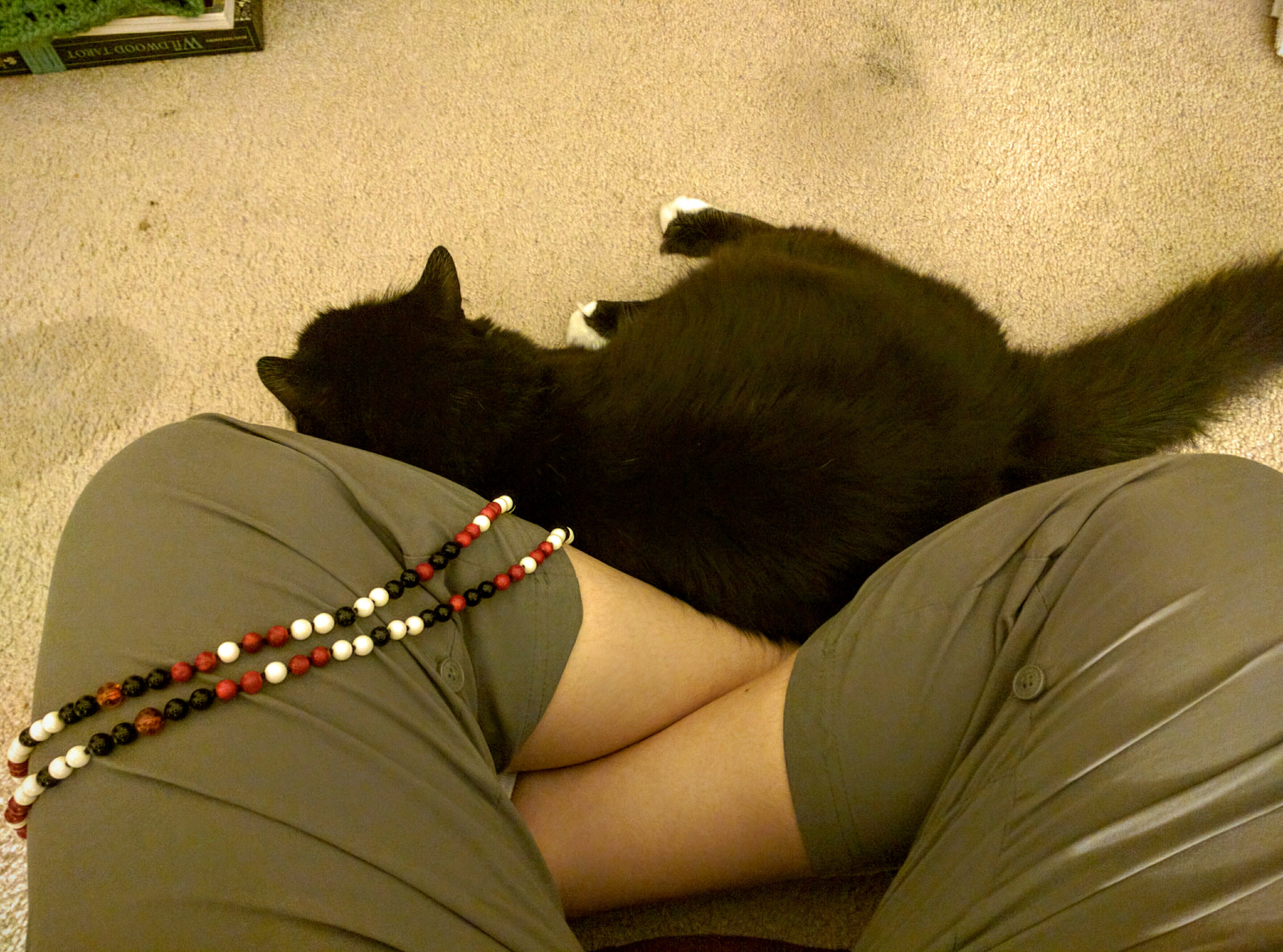
Meditation and Cats

For years, I have sat on the same purple cushion in the same little bedroom in front of the same little altar space to meditate.

I am still not allowed to do it without help.

meditation with cats

And no, I can’t just close the door. If I close the door, they sit and paw at the door and meow loudly in protest (there are two of them).

*Since I know someone will ask, the mala was handmade for me by Beth Wodandis, and I can’t recommend her services highly enough. This one is onyx, bone, coral, and amber, and I am absolutely delighted with it every time I pick it up to pray or do magic. I’ve had to keep myself from buying all of the prayer beads that she makes (I’ve had a problem with collecting prayer beads for a long time). Her etsy shop is here.  

Earth Along – Day 1

Three Cranes Grove is hosting an Earth-Along to honor Earth Day this year. It’s three days of individual practice that we all do “together” (in our separate ways) to honor the Earth Mother.

Earth Along - Day 1

You can find a full liturgy of offering to the Earth Mother at the Three Cranes Blog today as well.

I was planning on doing some garden work, and some meditation with my plants, as I tend my bit of earth and remember that I am the Druid of this Place… except that it just started pouring, and I am absolutely slammed at work. Perhaps tonight’s walk can be specifically dedicated to the Earth Mother (assuming it is not still pouring rain), and I’ll say hello to the trees I’ve planted in our neighborhood over the last few years. (My neighborhood does a tree planting day in February every year, to replace trees in the common area who have died or been damaged.)

I encourage you to find your feet on the Earth sometime today if you can do nothing else.

Hail to you, Hertha, Mother Earth
We ask that you support and surround us
For this rite, as you do for all rites,
For this day, as you do for all days.

Daily Ritual and Altar

I think it’s about time I repost and update my daily practice, since it’s been a few years since I’ve talked about it, and it has evolved a bit. First, though, my altar has some new items that I want to show off!

Altar - April 2016

This is just the working surface (which you can tell is used, by the amount of ash that I continually fight to keep cleaned up). I have a shelf full of deity and spirit icons/tokens above the tree, but it’s hard to get a picture of both that looks good.

The new items are the incense burner on the left, and the oil lamp in the middle.

Both are made by blacksmith David Cohen, at Dark Moon Forge in Austin. I’m lucky enough to know David in person, having met him at the Texas Imbolc Retreat the last two years, and he is a wonderful artisan. I purchased the incense burner from him last year, and then a few weeks ago he was posting on Facebook about the new oil lamps he was making to gauge interest. Typically he doesn’t do mail-order items, preferring to sell his wares in person in the Austin area, but I asked very nicely, and he mailed me my new lamp.

I had to wait a few days to get the lamp oil in (I’m using Firefly Clean Lamp Oil, since it’s odorless and smokeless), which was agonizing, but I’m SO happy with how it looks. I’ve tried various configurations of candles for the fire representation on my altar over the years, and never found anything I truly loved. I also had problems with candles getting weird and needing to be replaced because they were only lit for 5-10 minutes at a time. This lamp will burn for any amount of time, and I just love the leaf handle (which does allow me to carry it around, but since it’s an open container of lamp oil, I’ll have to be super careful with anything like that). I still love and burn lots of candles, but for my altar, I see myself using this oil lamp for a good long time.

Regardless, if you happen to be in the Austin, TX area, I can’t recommend Dark Moon Forge highly enough.

As for my daily practice, I first posted about it in June of 2014 as I was working on my first pass at the Liturgy Practicum class, before I had started on the Clergy Training Program. I typically do this practice at my mid-morning “coffee” break (I don’t drink coffee, but I like to get up around 10:30 or 11 and stretch a bit.)

Not a lot has changed, but I have added to it slightly, and I still feel like it’s not quite finished.

(Three breaths to center self)

Hail to you, Hertha, Earth Mother – may I always be supported as I walk in your ways.

The earth is below me, the heavens above me,
The flame lights the way! (Light lamp)

The earth is below me, the heavens above me,
The well flows within! (Fill/touch well)

The earth is below me, the heavens above me,
The tree spans the world! (Bless tree)

Let us pray with a good fire! (Light incense)

Eostre, Guardian of the Gates of Dawn, hold fast these gates that I may speak into the worlds.

I make offering to the gods.
May their power be with me this day. (Cense altar shelf)

I make offering to the ancestors.
May their wisdom be with me this day. (Cense altar shelf)

I make offering to the nature spirits.
May their blessing be with me this day. (Cense altar shelf)

The waters support and surround me
The land extends about me
The sky stretches out above me
At the center burns a living flame
May all the kindreds bless me.
May my worship be true
May my actions be just
May my love be pure
Blessings and honor and worship to the holy ones.

Mighty, Noble, and Shining Ones, thank you for your blessings and your presence.
Eostre, Guardian of the Gates of Dawn, thank you for keeping fast the ways.
Hertha, Earth Mother – thank you for upholding me always.

(Three breaths to center self)
(Extinguish lamp)

I always think it needs a daily rune draw, but I haven’t managed to figure out a good way to do that. If I leave my runes on my altar, I forget about them when I need them for ritual or study group meetings, and though I have a journal specifically for readings, I never seem to remember to write down what I drew. (I have a working memory like a rusty sieve these days.)

I also feel like I should make some kind of offering to the deities I’m working with by name (Ing Frea, Hela, Frige), as well as to my ancestors and house spirits, but I also don’t want to have a 15 minute practice. I’ll never remember to do the whole thing if it’s going to take more than just a few minutes. Perhaps I need to have a weekly practice to make specific offerings. Or maybe I need an evening practice to do?

I’ve talked to other ADFers, and they seem to have more “built in” practices – an offering to the ancestors with breakfast coffee, and the like. I have trouble starting anything like that due to just sheer forgetfulness, but with all the beings I’d like to be building *ghosti with, maybe I need to just send myself a bunch of reminders!

Anyway, this is obviously a work in progress – I try to balance as much oomph as I can get into a small bit of time, knowing that I’m most likely to actually do the offerings that way, and so far it works nicely.

Any thoughts you might have on polishing this into something a little more “complete” feeling would be really nice!

So ADF ritual has two main phases – an offerings phase, where we send all our love, devotion, and offerings through the portals into the otherworld, and a blessings phase, where we accept blessings in a “return flow” from the otherworld. Those blessings are concentrated into a sacred drink, called (usually) the Waters of Life.

Originally the Waters of Life were whiskey (or sometimes water). ADF ritual has expanded to include mead and other alcoholic beverages. The alcohol represents the “life” part. As Nine Waves got started, we typically had mead for our Waters of Life, since that fit with our hearth culture and was tasty.

However, a few things happened that got me thinking about including alcohol in our rituals:

  1. We now meet in a park that does not allow alcohol
  2. We now have an underage regular ritual attendee, and in Texas it is VERY illegal for us to give him even a sip of alcohol
  3. I have circled in the past with recovering alcoholics, who would not be able to partake of our blessings
  4. I myself am on medication that is contraindicated with alcohol, so I was dancing with danger already
  5. There is nothing in ADF ritual guideline that specifies that the Waters of Life must be alcoholic
  6. There was a spirited discussion on the ADF Facebook group about the topic, where several good arguments were made

We figured we could do two things – we could have two cups/mead horns, one with actual mead, and one with water (which presents a logistical issue, even in a group of only 10 people, and would still be breaking the rules of the park where we meet), or we could just go with a non-alcoholic option.

One of the best posts on the ADF Facebook discussion came from Ceisiwr Serith, who spoke of making his own sacred drink for rituals. His recipe included barley (which I can’t consume, having celiac disease) but it got me thinking about ways to make a sacred drink that we could all enjoy, that would feel special (since that’s important), but wouldn’t exclude anyone.

So I went digging for recipes, and came across some recipes for “soft mead” – basically honey water. And I got creative, and came up with the following:

Spiced Sacred Drink

  • 4 cups filtered water
  • 1 – 1.5 cups honey
  • 2 lemons
  • 2 inches fresh ginger, thinly sliced
  • 4 cinnamon sticks
  • 8 whole cloves

Using a vegetable peeler, remove the zest from the lemons. Place the zest, ginger, cinnamon, cloves, honey, and water into a non-reactive pot. Juice the lemons into the pot, but do not add the pithy white parts (that will make your drink very bitter). Put over very low heat for 3-4 hours, stirring occasionally. Strain into a container for transport to ritual. Serve warm or room temperature. (recipe can be halved, and most measurements are guesses anyway – start with this and tweak to your liking)

Nine Waves was, overall, very skeptical of my creation. They liked having mead, the alcoholic “life” was important, and it felt special to us to share mead from our mead horn together. But they humored me, and I have, I must say, converted them all. This is extremely tasty, especially warm on a cold night around a campfire, and it requires preparation and is “special” – I only make it for our rituals. And we now don’t have to worry about new people being averse to anything (other than a possible allergy to any of the sacred drink ingredients) or not being able to consume alcohol.

It’s a win for everyone. (And it really is tasty.)

2016 Spring Garden

The 2015 Spring Garden was almost a complete failure – the only thing that did well were the beans. So I’m back (from outerspace) with a new plan, some more mulch, a trash can full of compost, and plans to really *magic it up* this year. I am not content to just put the garden in the ground. This garden needs magic, or I fear it will go the way of last year’s garden, and I will get no tomatoes and be sad.

The container garden contains only herbs and one yellow squash plant that I’m attempting to make work. We’ll see:

  • cilantro
  • Italian oregano
  • straight neck yellow squash
  • scallions (green onions)

The actual garden bed contains:

  • Tomatoes (Arkansas Traveler, Globe, Sweet 100, Sweet Million, Yellow Pear, and Juliet) – almost all cherry tomatoes this year
  • TAM Jalapeno (3)
  • Sweet Banana Pepper (3)
  • Clemson Spineless Okra (4 hills of 2 plants)
  • Bush Blue Lake Beans (3 full rows)
  • Eggplant (Japanese Long)
  • Genovese Basil

The whole thing (except the bean rows, which haven’t sprouted yet) is mulched thickly with cedar shavings, which will hopefully help with weeds.

I’ve also got an order in for some “seed bombs” (mammoth dill, italian parsley, genovese basil, and mixed romaine) to toss in my garden bed with the aloe and the lime tree, to try to make something out of an otherwise useless little corner of garden. If it doesn’t work, I’m not super sad, but the seed balls look easy to use and sprout, and the bed gets lots of sun. That bed currently only contains the out of control aloe plants and Frank. Frank is my 15 year old oregano plant. He’s very hardy. At his largest, he was the size of a coffee table, but he’s much smaller than that now.

In the past, my most successful garden came after I blessed it with a drink that came out of a very powerful ritual. Next week is our Spring Equinox ritual, and so I think I will make extra of our sacred drink (remind me to post on that sometime) and use it to bless the garden. It’ll have strong blessings in it, and I can do a ritual myself to bless the ground. I’ve made a small earth mother talisman for our Druid Mooncast workings, so perhaps she will come and participate as well.

I really *really* don’t want another failed garden. It was so hard last year to look out and see it overtaken with weeds, not producing any fruit at all. I know I went and got a new job and spent the month of May living somewhere else, which didn’t help, but it still feels personal. So this year, I’m doing my best to ensure success.

Oh You Mothers

“Oh You Mothers…”

This is the prayer I use when leaving offerings for my own ancestors.

Oh you mothers, all my mothers

Those who sleep in heavy soil,

Those who went to death so weary

All you thought was no more toil,

Those who danced with joy and laughter,

Those who fought to break the chains

Though you’ll know no more hereafters,

Here a part of you remains.


Oh you fathers, all my fathers

Those who dream in wet, black earth,

Those who let their dreams go hungry

So that mine could come to birth,

Those who died in rage and sorrow

Those who laughed and wandered free,

Though you’ll know no more tomorrows

Your tomorrows live in me.


All of you who came before me,

Though I know your names or not.

All who added to my story

Giving blood or deed or thought.

Take this food and drink I give you,

Share it with me, take your fill.

Though your verses may have ended

Yet the song continues still.

– Christopher Scott Thompson

I am not, very often, a dreamer. I’ve tried all the usual things – notebooks by the bedside, intentions before sleep, mugwort tea, valerian capsules, etc. I’d blame it on the medicine I take for neuropathic pain that keeps me in deep stage sleep longer, but I wasn’t a dreamer growing up either, so it’s not like much has changed. (I had night terrors as a child/teen, but I only very rarely remembered what they were about, only that I woke up terrified.)

But then, every once in a great while, I have a DREAM. In this case, an exceptionally vivid one that – three hours later – is only just now starting to fade.

In this dream, I was working with an artisan to create a rosary to Cerridwen (I think) and Herne.

This is interesting for a few reasons, beyond just the fact that I remembered a dream very vividly.

I haven’t worked with Cerridwen and Herne for several years. They have a space on my altar still, of course, as a tiny cauldron and a wooden acorn, but they aren’t Gods I typically associate with my current practice. Herne is not far off my current Anglo-Saxon practice, being an English God, and being that it is Wild Hunt Season, but it was curious to hear from Cerridwen. (On a night just after the full moon, on the eve of Samhain, so maybe not so curious.)

Their names are the names that I used for the God and Goddess in my days as a Wiccan. (I am not an initiated Witch, and I am Quite Sure these names are not the oathbound names that witches are affiliated with.)

Now. I’m not exactly much of a Wiccan anymore. I occasionally do Witchy magic, but my following the wheel of the year has a distinctly Druid flavor, and I’m pretty entrenched in ADF and the Anglo-Saxon hearth culture.

But my practice has been pretty stagnant recently, and when I consulted people who are skilled at divination, the common answer was “you’re doing too much, you need to take care of your own practice, find your big Why, and turn inward for awhile.” They also said not to be tempted by “spiritual squirrel syndrome” – where anything shiny and new seemed exciting and worth pursuing. (I asked three diviners, and got three VERY similar answers, from three completely different systems of divination. I’m inclined to trust that answer.)

So why, suddenly, are these Gods from my past knocking at my door again?

Lammas Blessings

Nine Waves Protogrove gathered tonight in the park, under the late summer sun, and around an open fire, to celebrate Lammas. Our ritual honored Frea, the Golden Grain God, and celebrated not only with praise and offerings, but also with a personal sacrifice from each person, that they are willing to give up until Samhain to ensure a good harvest this year.

While we did not announce our sacrifices, I know mine will be hard to keep. I dunno if it’s the Wiccan background, but I take Lammas sacrifice VERY seriously. The harvest is a thing you don’t want to fuck up, especially when your surviving the winter depends on it. And with all the hardship that’s going around in our country, I figure a good harvest is something we all need right now. (With as badly as my garden did this year, I figure a difficult sacrifice is due – I got very little personal harvest this year, so I’m going to have to rely on my community until next year’s garden.) While Lammas is definitely a celebration – it is a High Day after all – it’s also a serious occasion and one that it’s important for us all to be mindful of each time we pick up a bag of fresh apples in January at the grocery store.

We also read the Tale of John Barleycorn – which you can listen to here: https://www.youtube.com/watch?v=t8878chOvfI (This is a slightly different version than the one in my book, but it’s the more famous version by far.)

Our next ritual will be for the Autumn Equinox, and will celebrate the second harvest. Our ritual focus hasn’t been selected yet, but we’ll announce it as soon as we have it planned.